Sudarshana Chakra & Lord Vishnu – The Divine Oneness and the Path of Bhakti
Discover the relationship between Lord Vishnu and the Sudarshana Chakra, the story of King Ambarisha, its spiritual meaning, scriptural references, and the path of Bhakti according to Hindu scriptures.
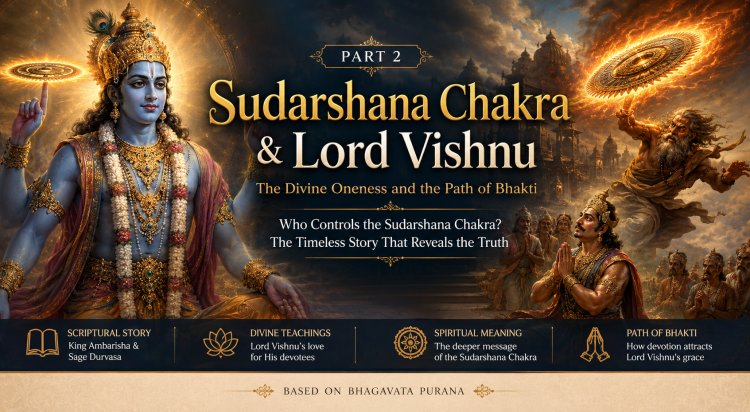
Who Controls the Sudarshana Chakra? The Timeless Story That Reveals the Truth
Category: Scriptures | Lord Vishnu | Sudarshana Chakra | Hinduism
New to This Series?
This is Part 2 of our Sudarshana Chakra series.
If you haven't read the first chapter, we recommend starting there.
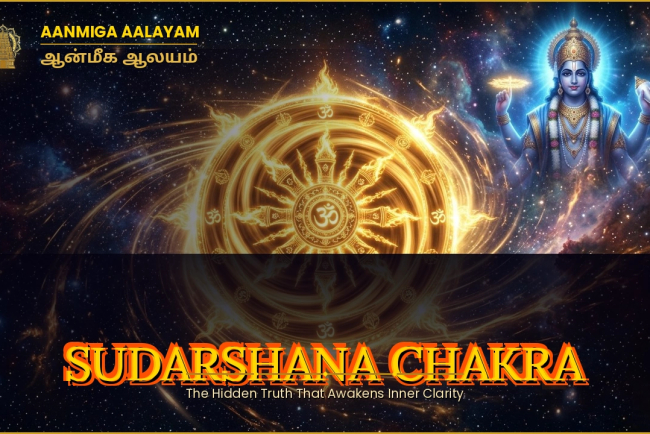
Part 1: Sudarshana Chakra – The Hidden Truth That Awakens Inner Clarity
In Part 1, we explored:
- What the Sudarshana Chakra truly represents
- Why it is more than Lord Vishnu's divine weapon
- Its deeper symbolism in Hindu scriptures
- How it represents Dharma, cosmic order, and divine clarity
Read Part 1: https://aanmigaalayam.in/sudarshana-chakrathe-hidden-truth-that-awakens-inner-clarity
INTRODUCTION – EVERY POWER HAS A SOURCE
Every great power has a beginning.
A mighty river begins as a small spring.
A towering tree begins from a tiny seed.
Even the brightest light has its source.
Then what about the Sudarshana Chakra, one of the most powerful divine symbols in Hinduism?
For centuries, devotees have seen Lord Vishnu holding the blazing discus in His hand.
They know it protects Dharma.
They know it destroys evil.
They know it is unstoppable.
But very few stop to ask a simple question.
Who controls the Sudarshana Chakra?
Is it merely a divine weapon?
Or is there a deeper relationship between Lord Vishnu and the Sudarshana Chakra?
To understand that answer, we must journey into one of the most remarkable episodes narrated in the Bhagavata Purana.
A KING HISTORY REMEMBERED DIFFERENTLY
History remembers many kings for the lands they conquered.
Some are remembered for their wealth.
Others for their power.
But there was one king whose greatness was measured neither by his army nor by his kingdom.
His name was King Ambarisha.
His greatest strength was his devotion to Lord Vishnu.
Every day of his life revolved around Dharma.
He ruled his people with compassion.
He respected sages.
He served his kingdom selflessly.
And above all, he surrendered every action to Lord Vishnu.
THE DAY DEVOTION WAS TESTED
Among all his spiritual practices, the observance of Ekadashi was especially sacred to King Ambarisha.
After completing his fast, the scriptures required him to break it during the sacred time of Dwadashi.
On that very day, the renowned sage Durvasa arrived at the palace.
The king welcomed him with folded hands.
"Please bless my home by accepting a meal before I complete my fast."
Durvasa graciously accepted.
Before returning for the meal, however, he went to the nearby river to perform his daily rituals.
Time slowly passed.
The sacred moment for breaking the fast was approaching.
King Ambarisha found himself standing between two sacred duties.
If he waited beyond the prescribed time, he would fail to complete his religious vow.
If he began eating before his guest returned, he would fail in his duty as a host.
Seeking guidance, he consulted the learned sages present.
They advised him to sip a small amount of water.
According to scriptural tradition, this would preserve the fast without beginning the meal.
Trusting their wisdom, the king quietly sipped a few drops of water.
Then he patiently waited for Sage Durvasa.
WHEN ANGER MET DEVOTION
When Durvasa returned and learned what had happened, he believed the king had insulted him.
Known for his fiery temper, the sage became furious.
In his anger, he plucked a strand of hair and created a terrifying fiery being to destroy King Ambarisha.
The royal court trembled.
But the king did not.
He neither reached for a weapon nor ordered his soldiers to fight.
He did not argue.
He did not defend himself.
He simply stood in complete remembrance of Lord Vishnu.
And then...
Something extraordinary happened.
Without hesitation, the Sudarshana Chakra manifested.
Its radiance illuminated the surroundings.
Within moments, the fiery being was destroyed.
But the divine discus did not stop there.
It turned toward Sage Durvasa.
For the first time in his life, the great sage fled.
A JOURNEY ACROSS THE THREE WORLDS
Durvasa sought refuge everywhere.
He approached Lord Brahma.
Brahma explained that he could not intervene.
He then sought the protection of Lord Shiva.
Shiva too could not stop the Sudarshana Chakra.
Finally, exhausted and frightened, Durvasa reached Lord Vishnu in Vaikuntha.
Surely, the Lord who held the Sudarshana Chakra would command it to return.
But Lord Vishnu's answer became one of the most treasured teachings of the Bhagavata Purana.
LORD VISHNU'S REPLY
Lord Vishnu spoke with great compassion.
He explained that He is deeply bound by the love of His devotees.
The Bhagavata Purana describes the Lord's special affection for those who surrender to Him with sincerity.
He instructed Durvasa to return to King Ambarisha and seek his forgiveness.
Only then would peace be restored.
Durvasa returned.
The king welcomed him without anger.
There was no pride.
No resentment.
Only compassion.
King Ambarisha prayed for the sage's well-being.
Only after reconciliation did the Sudarshana Chakra withdraw.
The story ended not with revenge.
But with forgiveness.
Not with victory over an enemy.
But with the triumph of humility.
WHO REALLY CONTROLS THE SUDARSHANA CHAKRA?
This episode invites us to think more deeply.
Is the Sudarshana Chakra merely a weapon?
Within the Vaishnava tradition, the Sudarshana Chakra is revered as Lord Vishnu's divine discus and is understood as acting in complete harmony with His will. It is never portrayed as acting out of personal ambition or emotion.
Its purpose is to uphold Dharma.
To protect sincere devotees.
To preserve cosmic order.
Rather than seeing the Sudarshana Chakra as separate from Lord Vishnu, devotees understand it as one of the sacred expressions of His divine power.
WHAT DOES THIS STORY TEACH US?
The story of King Ambarisha is much more than an ancient legend.
It is a reminder that faith is often tested during life's most difficult moments.
Ambarisha did not respond to anger with anger.
He did not answer violence with violence.
His greatest strength was his unwavering trust in the Divine.
For devotees, this story teaches that humility, patience, forgiveness, and steadfast devotion are among the highest forms of spiritual strength.
HOW CAN WE DRAW CLOSER TO LORD VISHNU?
Many people ask,
"How can I receive Lord Vishnu's grace?"
The scriptures consistently praise the path of Bhakti.
Remember His names.
Listen to His divine stories.
Live according to Dharma.
Serve others with humility.
Speak truthfully.
Practice compassion.
Offer every action with gratitude.
These practices gradually transform the heart.
And a heart transformed by devotion naturally becomes receptive to divine grace.
THE DEEPER MESSAGE
The Sudarshana Chakra reminds us that divine power is never separated from compassion.
Justice is never separated from mercy.
Protection is never separated from love.
For generations, devotees have found inspiration in this episode because it reveals that the Lord's greatest strength is not merely His power but his unwavering care for those who walk the path of Dharma.
CONCLUSION – THE JOURNEY CONTINUES
The story of King Ambarisha reveals that true devotion is not measured by miracles.
It is measured by character.
By humility in moments of success.
By patience in moments of hardship.
By faith when fear surrounds us.
As we understand the Sudarshana Chakra more deeply, we begin to understand Lord Vishnu more deeply as well.
Yet another mystery still remains.
If the Sudarshana Chakra protects the universe...
Can it also transform the human heart?
Can it remove ignorance just as it removes danger?
Why do saints and spiritual teachers describe it as a symbol of right vision and inner awakening?
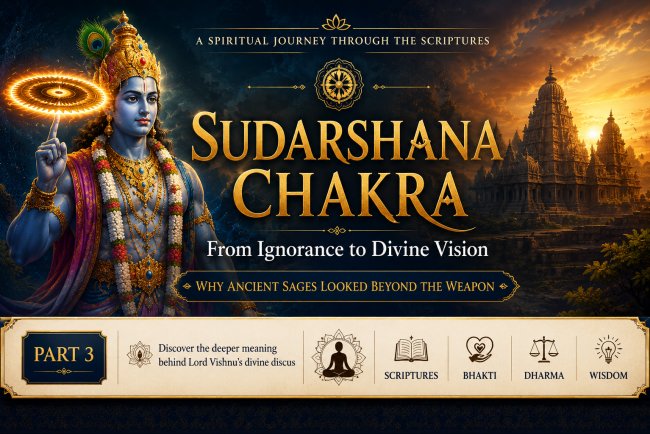
In the next chapter, we will explore the deeper spiritual symbolism of the Sudarshana Chakra, the meaning of "Su-Darshana", and how this timeless symbol continues to guide seekers on the path of Dharma, devotion, and wisdom.
Scriptural References
- Bhagavata Purana – Skandha 9 (King Ambarisha and Sage Durvasa)
- Vishnu Purana – Lord Vishnu as the preserver of Dharma
- Bhagavad Gita – Teachings on Dharma, Bhakti, and surrender
What's Your Reaction?